Skip to content

Posts by Isaiah Berg

Highway One Diaries: Peace by the Sea

All_good_things_must come to an end, or so the saying goes.  Highway One and its stories ended for us in La Paz near the southern tip of Baja California.  Riding south along the Sea of Cortés and weaving back once more through the harsh deserts near Constitución made us anxious for the end of a long road stretching back to northern California.  Our time on Highway One ran out and so this marks the last Highway One Diary for Bound South.
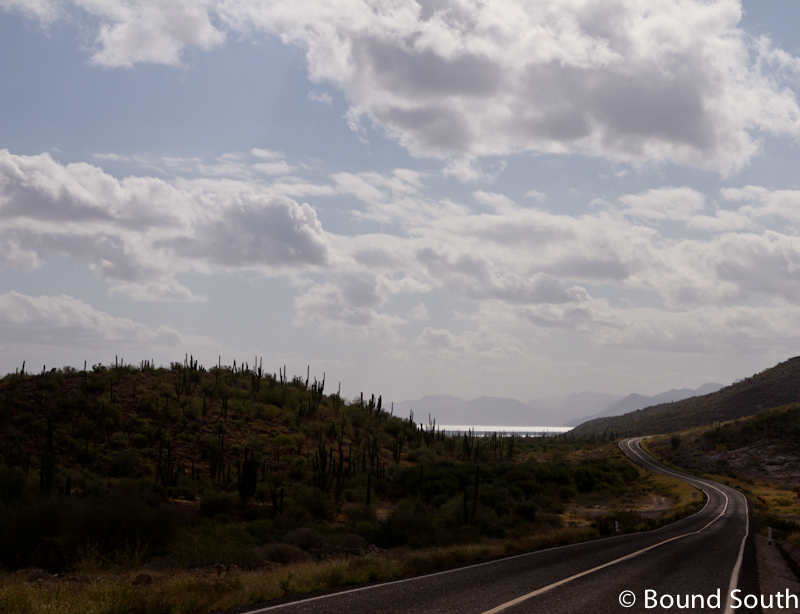
Mountains abound in the Baja.

La Paz, “The Peace” by the sea, appeared on the horizon with no time to spare.  The desert was wearing on us.  Our last night before reaching the city we found ourselves on a desolate stretch of Highway One with little water, little food, no supplies within 40 kilometers, and worse yet, solid barbed wire fencing along each side of the highway.  Any good bicycle expedition depends on fortuitous gaps in the cattleman’s or farmer’s fence.  Through those gaps and into the wilderness we camp out of sight and leave in the morning, leaving nothing but tire tracks.  When no gaps exist, we are forced to get creative; which in this case meant sleeping under a bridge that hummed and grumbled over us with every passing vehicle.  Lest you get any romantic ideas about our brave campsite, it smelled like poop.
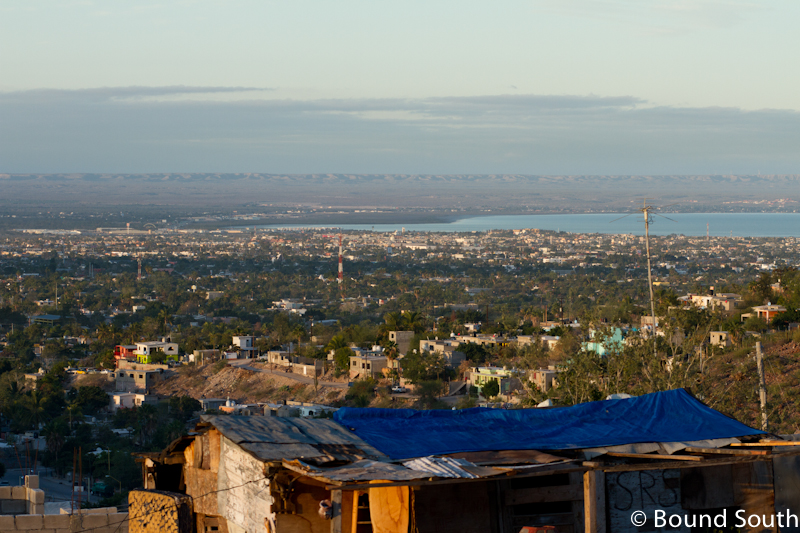
Looking over the city from the southern outskirts.

But then again, we probably did too.  Lots of time and sweat and effort finally got us to La Paz, where the generosity of a Canadian family and a local church community connected us with unparalleled goodness.  We stayed in tremendous luxury atop a hill overlooking the marina and its waterfront illuminated by city lights at night.  David ran through a hellish college application gauntlet.  Nathan ate absurd amounts of fresh fish tacos.  I got to see my girlfriend.  We spent some time by the ocean and the sights and sounds and smells of an authentic, working Mexican city.  We went to church.  We kayaked through a pack of jumping dolphins.  We volunteered to help serve breakfast to numerous children in one of the poorer colonias on the outskirts of La Paz.  One night, we ended up in a very questionable Mexican bar.
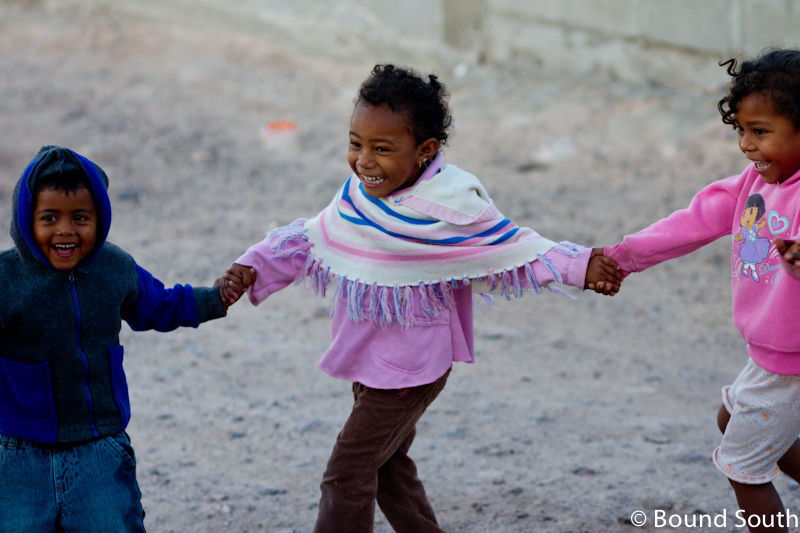
Children learned my favorite game from Dartmouth's DOC Trips.

The magic passes by quickly, but the memories stay and sustain us as we ride further.  La Paz was monumental for us; it was a kind of natural checkpoint, Nature’s confirmation that we’d done a pretty fine job of bicycle riding, and that it was time to ride a ferry across the sea.  It felt like luxury, but perhaps the goodness and wonders of strangers and new lands is instead a necessity we all go without too often.  Having repaired our bicycles, said our good-byes, and relished our last days of rest, we rode our bicycles over mountainous roads to Pichilingue where a Transportacion Maritima de California cargo ferry took us overnight to Mazatlán and the mainland of Mexico.  This good thing, Highway One, has come to an end; yet the road and its people and its landscapes wait for us should we ever have the privilege to return to it once again.
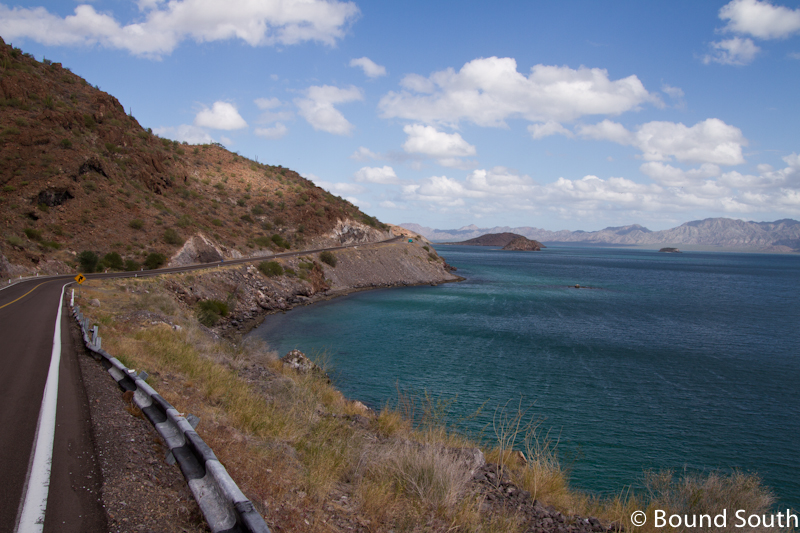
Portions of Highway One along the Sea of Cortés make California jealous.
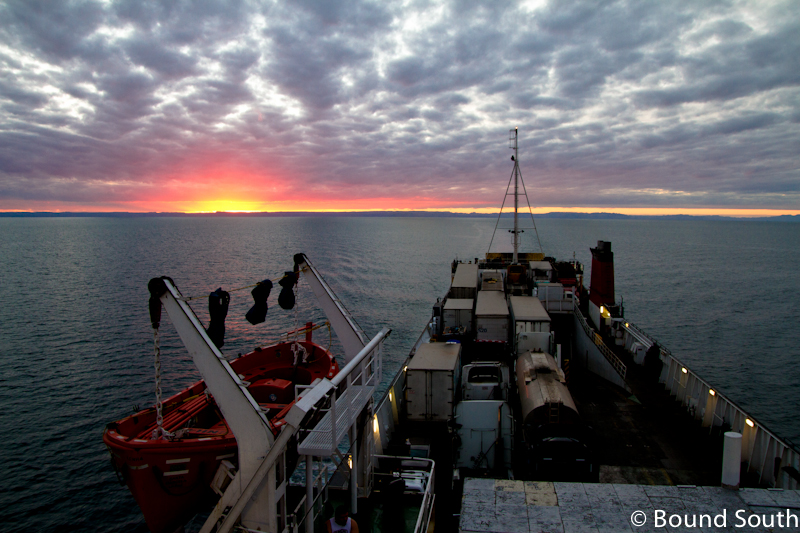
Our cargo ferry across the sea to Mazatlan. We slept on the deck in our tent.

Merry Christmas

Guadalajara_and_North Dakota are worlds apart.  Today the distance shrinks.  In Mexico and at home, love abounds, family is primary, and somehow snow is nowhere to be found.  May you all find joy and love with your family this Christmas Day and reflect on that rare blessing that you possess in the company of your loved ones.  Merry Christmas!

Angus dressed for work in his festive Mexican Christmas attire.

A Guadalajara Christmas with the Salazar Family.

Gear: Tale of Two Bicycles

Surly_is_a_pretty cool company.  They make bikes, really good bikes, bikes built out of chromoly with strong welds and good character.  Just ask a guy named Troll.   We all chose the bike named Troll for Bound South and have built three of them nearly identically to one another.  Yet we have all developed individual relationships with our bicycles and our gear since leaving Alaska.  Bicycle touring is certainly not all about this equipment; there are many tourists who could probably get by on used hybrid bikes and backpacks.  One has to keep everything in perspective and take nothing for granted.  We are thankful everyday for what we have: a superb bicycle and three bags of stuff each.  This post marks the first step in a series chronicling all the stuff of Bound South that you usually just glimpse in pictures; the Trolls, the trinkets, the tools, the tent, the luxuries and the immense satisfaction that comes when the little things don’t let you down.

David's Troll, named Goliath, all dressed up for work.

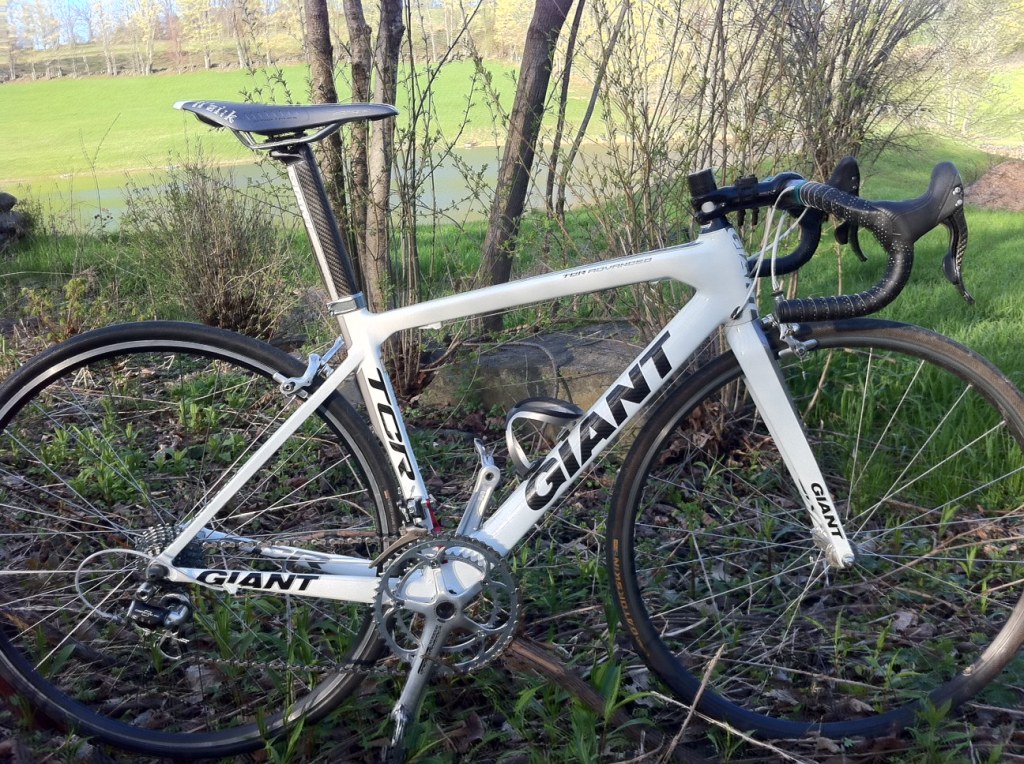
The bikes are a natural place to begin.  If our Trolls could be personified, they would be much like Surly’s officially unofficial spokesman: they are honest, unusual, they ride lots, and they do great with laughter.   Within a few days of leaving Alaska, I had christened my Troll Angus.  There was no real reason, except that I was raised on a farm-and-ranch, love a good steak, and thought that the name suited my bicycle.  My day begins with  “Good morning, Angus, today seems like a good day to kick butt, don’t you think so?”   This bicycle is a tractor with panache.  It can do just about anything.  I do have another bicycle at home, though.   To be completely honest I have three but I don’t like to dig too deeply into the ugly details of my addiction.  Don’t tell Angus.  We’ll focus for now on my Lieutenant, my go-fast bike, my pretty little thing that weighs 17 lbs and speaks Campagnolo.  It’s my Giant TCR Advanced road racing bike that I picked up after my Bianchi cracked.

A bicycle for a different kind of riding.

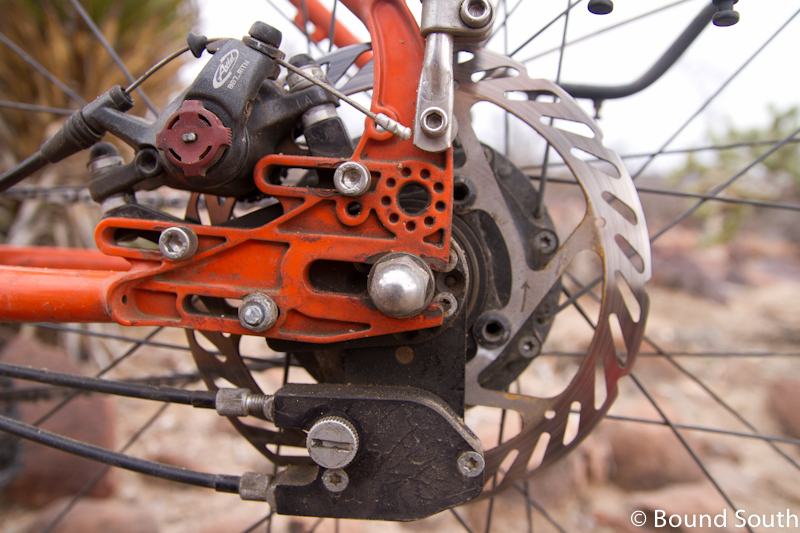
If I want to race or to fly around the roads on a training ride, my Giant is my dream bicycle.  If I want to get groceries, it’s like a Ferrari with no trunk.  Before Bound South, I had never seriously ridden anything other than a road racing bicycle.  The zen of skinny tires and humming pacelines was all I knew.  When I first took a ride with Angus that fateful day in Fargo, ND, I was admittedly a little bit hesitant.  Angus is heavy.  Angus rolls a little slower with big, heavy, fat, bulletproof Schwalbe Marathon tires.  Angus is designed to be flicked around dirt singletrack like its brother the Surly’s 1×1.  Unloaded, Angus can be twitchy on the road due to its dirt-optimized geometry.  He behaves very nicely on pavement and dirt while loaded.  What can I say?  Angus possessed everything we needed to ride from Alaska to Argentina and he could carry it with class.  Angus was a new friend yet somehow also the bicycle I’ve known my entire life.  Angus represents a beautiful marriage of theory and practice; he is a chromoly touring bike that can run sturdy Surly racks, bombproof disc brakes, broad fenders, fat tires, and God’s uber-German-bicycle-gift to man: the Rohloff.  Angus forced me to reconsider what I could expect of a bicycle.

Fourteen speeds of internal and indestructible magic.

Angus and other bicycles like him represent an idea that I find intoxicating.  That idea is that bicycles shouldn’t be limited.  If your bicycle is only a weekend exercise machine that has your back screaming in an uncomfortable position, chances are that it will hang dusty and unused.  If your bicycle is only a rusted commuter with no brakes that risks your life with every cross-campus trek, it probably won’t last long before it hits the trash heap.  Angus would have me believe in the celebration of form and function; that a bicycle can be your beautiful commuter, your grocery store getaway, and your trail explorer or bicycle camper on the weekends.  Or maybe it can take you all the way to Argentina, if you’ve got the legs and the will and the time to let it take you there.

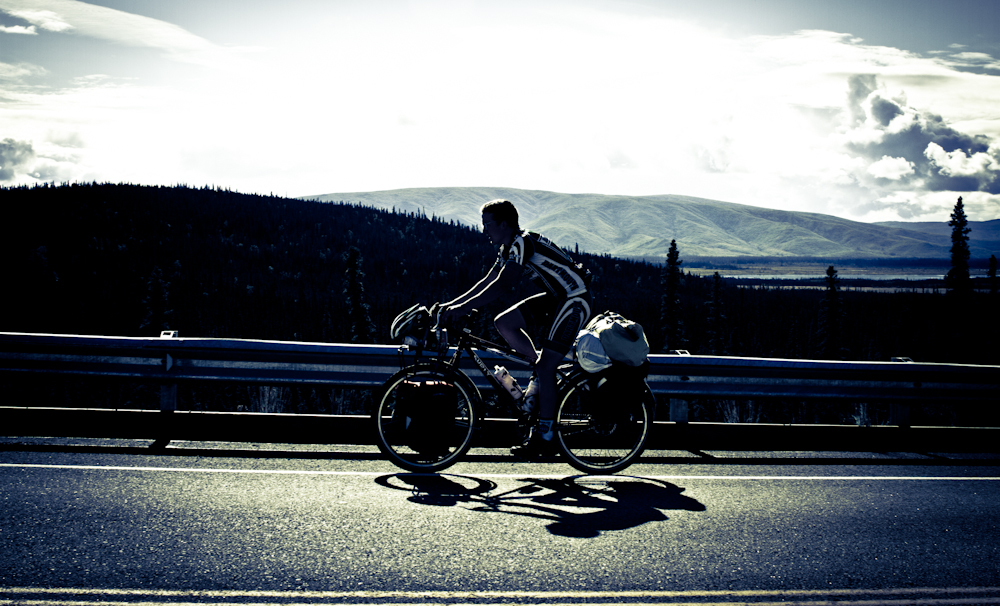
Climbing in Alaska, a world away it seems.

A few people really get this, and with any luck they’ll shake up the world and get more of it back onto a bicycle.  It seems a world away, but I think of our past photography presentations at Bend Velo in Bend, Oregon and Velocult in San Diego, CA.  These were highlights of our journey through the United States where we stopped at a bicycle shop, put our photography on a screen, and met the local cycling community.  We shared our story and learned more about the places we were traveling through.  These were shops where the owners really got it.   Too many people have forgotten what makes bicycles so powerful and so functional and so beautiful: they become intertwined with our everyday lives.  Here’s to hoping that shops like this can thrive and make a difference.

Bend Velo, one of the shops we presented at in Bend, OR.

As for Angus, we’ll be hopelessly intertwined for a very long time.  Assuming Angus doesn’t die or run away, he’ll be around for the rest of my life, serving as my faithful companion through hardship and illuminating new horizons with every turn of his wheels.

Functional, mechanical elegance: rotor, brake, hub, shifting assembly, dropouts.

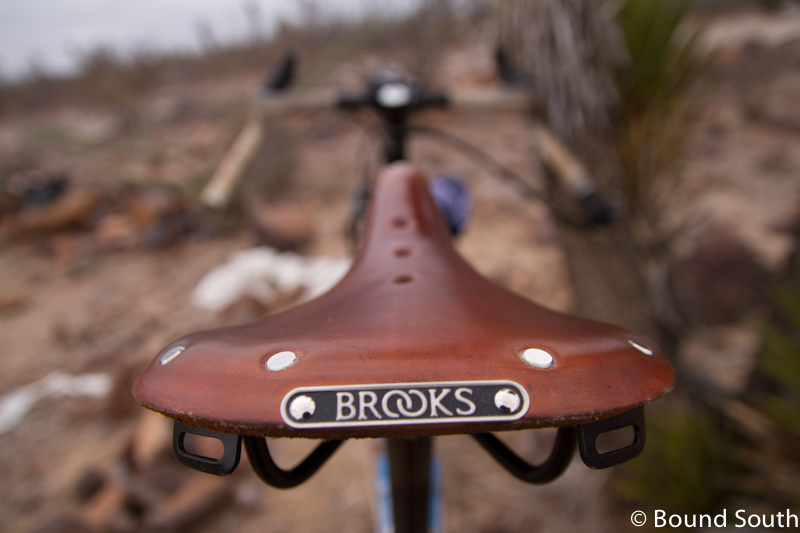
Brooks: Do your butt a favor, please, and get a leather saddle.

Climbing the cobblestones up to our home in La Paz.

Highway One Diaries: Land of Pointy and Mean

The_urgency_of_crossing borders propelled us quickly through the borderlands of Mexico.  We figured that the further south we were, the safer we were.  Furthermore, as the traffic and city lights of Ensenada and Tijuana were left behind us we regained our familiarity with empty landscapes, quiet roads, and a date with Mother Nature in a new dress.  Welcome to the desert, the “land of pointy and mean” as I coined it outside El Rosario.

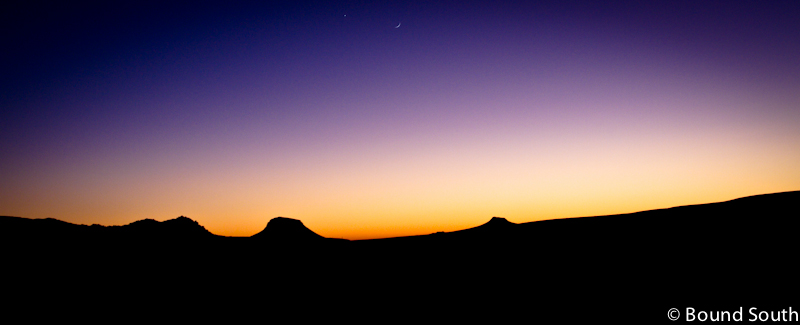
Clear desert skies

This desert was the real deal.  We were warned to fill up on water and supplies at El Rosario before pressing on into the 400k of desert separating if from Guerrero Negro.  Water conservation and carrying capacity was of paramount importance in desert heat and pronounced isolation.  Replacing our staples of bread and jelly were new staples of tortillas, rice, beans, and whatever else we can find cheaply and in abundance.  Lots of desert camping and desert lessons lay ahead, yet we had little idea of what to expect as some people warned us of a desolate desert with no civilization for over 140k; others said we would be just fine and would see spots to replenish food and water every 60k with little trouble.  Local knowledge can be comically unreliable which is why one must learn to laugh.

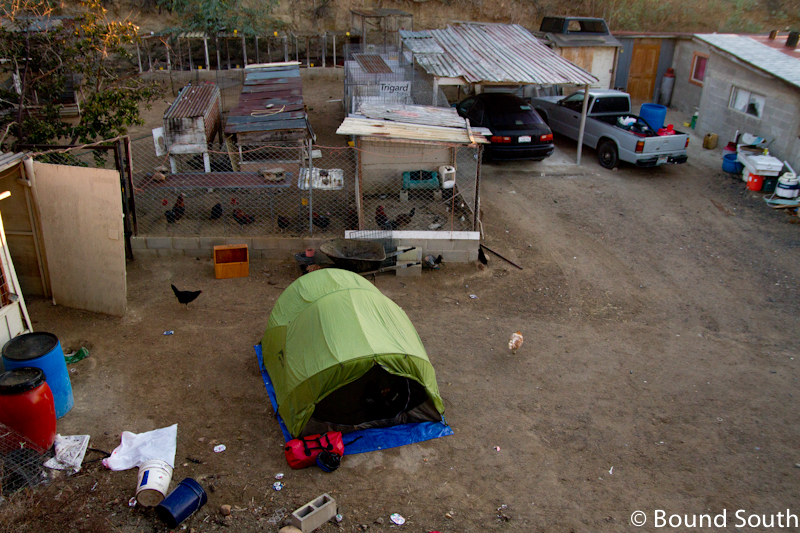
Camping near chicken coops isn't always pleasant. Early morning for us in El Rosario.

Laughter has sustained us through what was easily some of the most miserable camping of Bound South.  Who could forget the night outside of Guerrero Negro when we decided to sleep under the stars during a pleasant, cool night in the desert, only to find a dense fog descend upon us in the early morning and soak us and our sleeping bags.  Lesson learned: even when the sky is absurdly spectacular to look at, don’t bother sleeping outside the safety of a rain fly and a good tent.
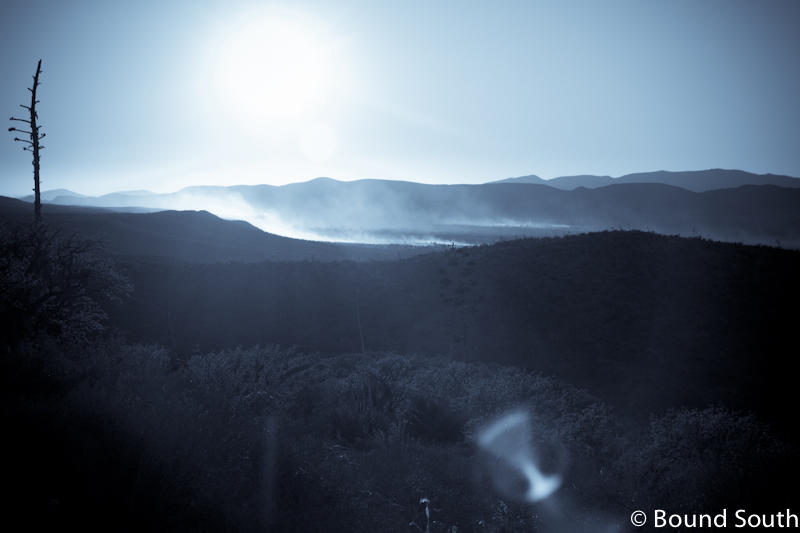
Fierce winds howl through a desert valley near Punta Prieta.

We fought vicious crosswinds through much of the desert and mountains south of El Rosario.  Usually we maintained our high spirits by reminding one another that “thousands of people envy us” and that if bicycle expeditions were easy and fun, everyone would be doing them.  One evening, after battling through hard crosswinds (enough to throw us off the road on numerous occasions) we decided to take a cattle road up through dirt and stone into the hidden desert brush of an august plateau above Highway One.  A strong but manageable wind was blowing as we set up camp and ate our simple dinner of rice and beans on our MSR stove.  The wind began to intensify.  As we were reading and preparing to sleep, David and Nathan noticed that the wind was still increasing in force and that the tent was slowly collapsing around us.  What followed was a feat of brotherly teamwork and haphazard desert camping ingenuity.  With 40mph winds and plunging temperatures, Nathan and I shivered as we assembled outside of the tent to hold it down.  David pulled stakes in order to rotate the tent to more aerodynamically face the wind.  Stakes once more in place, the tent was still collapsing.  Undaunted, Nathan had the idea to throw our bicycles into the brush and then anchor bungie cords to the bicycles and the tent in order to reinforce it against the fierce winds.  The wind and the sound of the rain fly was nearly deafening.  We slept safely in a reinforced tent that night, but everything we owned was covered by dust the next morning and the wind was blowing just as fiercely.  We were reminded of a warning from a restaurant owner we had met the day before: “We don’t waste money on paint here in the Baja.  Any of our sandstorms will blast it off in a matter of days.”  Lesson learned: camp in places well sheltered from the wind.

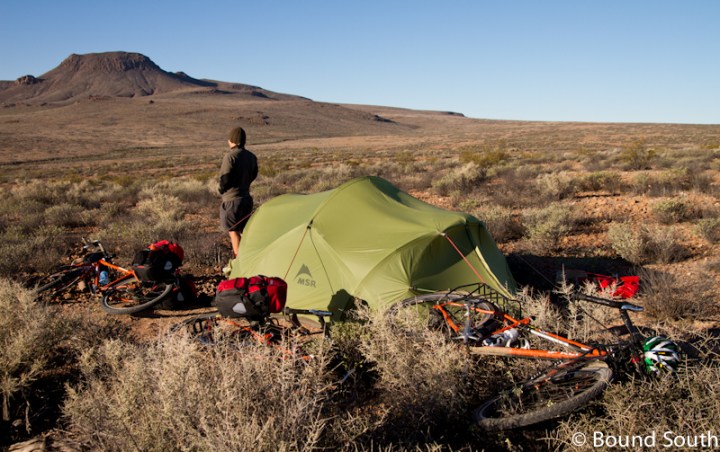
Desert winds whip against our reinforced tent.
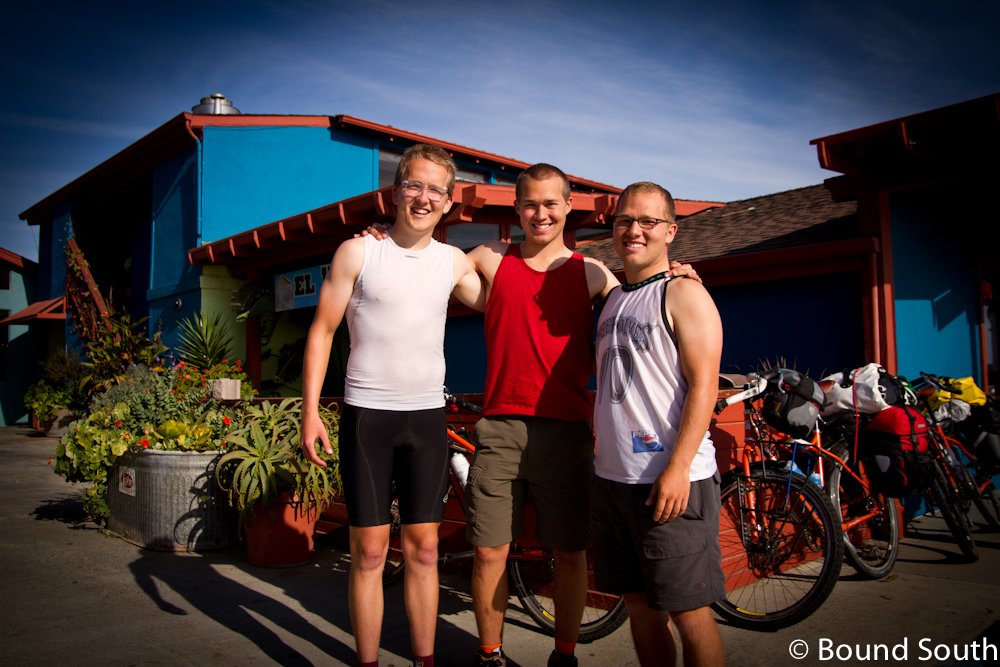
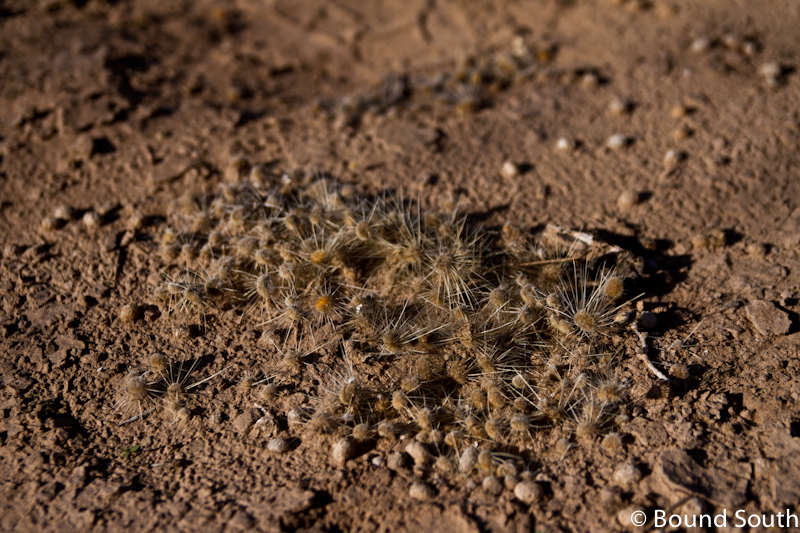
There have been other lessons, less dramatic but no less poignant.  After taking care of business 50 yards away from our tent one night, I discovered that my headlamp was out of batteries and my steps suddenly painful.  Desert thorns and native species of cacti had successfully sent 3/4″spikes through the soles of my flip flops that stabbed me with every step.  I walked back wincing on the balls of my feet, praying that I didn’t walk into a cactus or step onto some other godforsaken member of the kingdom Plantae.  Why anyone would choose to live in a place like this remains elusive to me.  I am reminded of what most of my friends think about North Dakota.

Land of pointy and mean

The desert is an austere, beautiful place.  We had to learn to respect it.  I still have no love for the sand, the harsh vegetation, the nonexistent wildlife, the terrifying insects, or the pitiable donkeys and cattle that graze the scraps of green scattered across the brush and cacti.  It is probably best for the desert to simply be feared, but if it is to be loved, it should be loved for its constancy.  No amount of human ingenuity or force of will can wring water from its ground or bring rain to its hills or people to its vast empty spaces.  It is a landscape in beautiful stasis, defying the frenetic cycles of life and offering a great empty space for the mind to explore.

Highway One Diaries: Risk Beyond Borders

Bound_South is about the Americas in their purest form.  We proudly call America, the United States, our home; yet this journey forces us to see the long American road between Alaska and Tierra del Fuego without the tinge of nationalism.  This is especially true as we move to foreign soil and experience new cultures and communities.  There are technicalities such as border crossings and language barriers and entry visas; yet in my mind’s eye I see the Americas and all of its roads and mountains and oceans and people, stripped of political complications.  Give me a long road with empty spaces to fill our vision and kind people to fill our hearts.  That’s it.

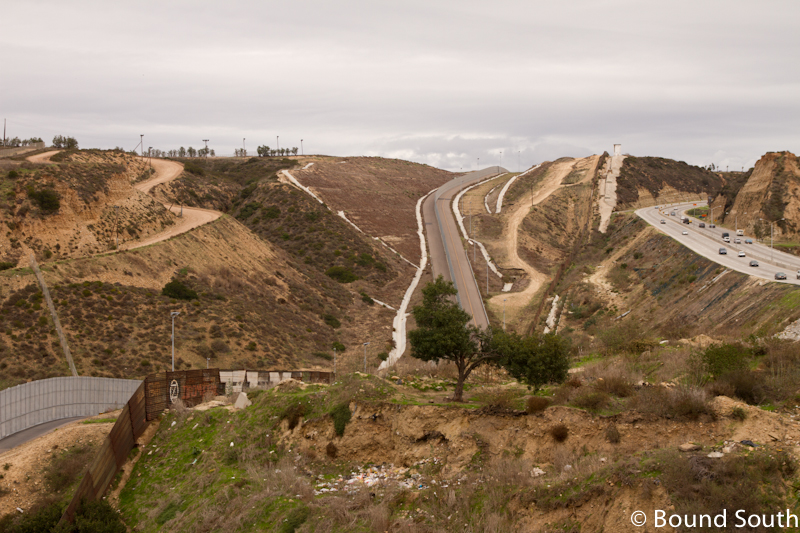
Our last glimpse at the US-Mexico Border

These invisible borders have consequences that cannot be ignored.  The American media profiles the drug wars that rage across the US-Mexico borderlands.  We’ve lately received quite a bit of media attention ourselves, culminating in a Los Angeles interview with the Agence France Presse, one of the world’s biggest news wire services along with Reuters and the Associated Press.  Our story was picked up everywhere from Canada and the States to Brazil and Indonesia.

A great deal of the interview was concerned with Latin America and the perceived and real dangers that would greet us there.  This mirrored the questions of countless people we had met since leaving Alaska.  Our willingness to bicycle through Mexico, Central America, and the western countries of South America earns us a reputation for craziness; though riding a bicycle as far as we have is probably enough to earn the badge as well.

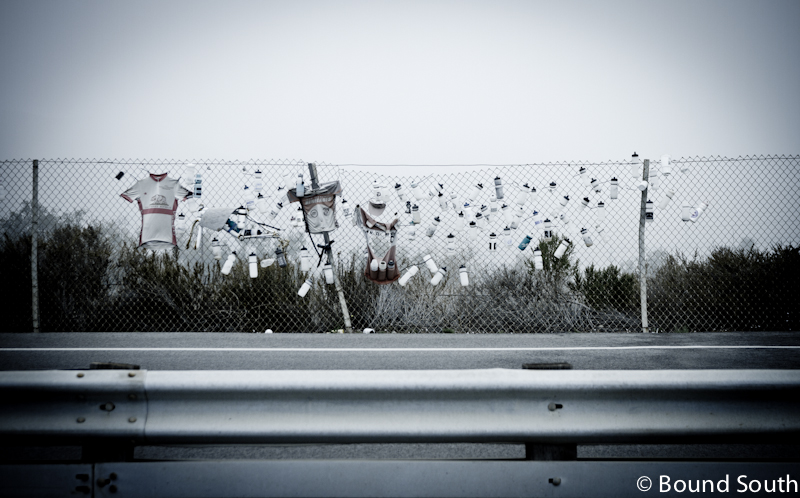
Riding through Camp Pendleton in southern California, we came upon a roadside memorial to a cyclist who had been struck and killed.  A jersey, dozens of water bottles, and various cycling objects were affixed to a chain link fence in memory of the tragedy.  I shudder when I think about the thousands of vehicles that have passed by us since we left Alaska.  Any one of them could end our lives with a mistake.  All cyclists are aware of this; you control the risks when you can, but ultimately it is but for the grace of God that we do not go where too many do.  David and I will never forget the most hair-raising part of our riding on this trip; it was on the Alaska Highway in the middle of the Yukon.  An RV rolled by us at 70mph while we hugged the right shoulder.  What terrified us was that the owner had forgotten to retract his step ladder that hung out the right side of his motor home like a crude scythe.

Never before have we seen so many waves, peace signs, and cheers from truck drivers.

Memories like that attune you to the constant risks that face us on the road.  We are not necessarily more endangered in Mexico or safer on a rural Oregon highway.  We don’t leave our brains behind at border crossings.  And we recognize in the pure image of the Americas without borders, there will be danger and beauty and goodness wherever we go.  Riding out of San Diego and into Tijuana, we were on edge because of all we had heard since leaving Alaska.  Yet we found that truckers were more friendly than any we had seen on the trip thus far.  Strangers cheered us from the side of the road.  Roadside litter and a more “interpretive” approach to traffic laws marked a clear departure from the rest of North America; not worse, simply different.  We have begun a long road, bound south through this splendidly different Latin America.
Mailbag Monday #4

Today_we_continue our Mailbag Monday series…

Dear Isaiah,

Are you having a good time?  Do you like the food there?  I like the food here.  It’s about to be Halloween.  I’m going to be a Metel scull rider.  It’s realy cool.  I live on a ranch.  Where do you live.  I have 26 horses, 1500 cows, 5 dogs, 30 cats!  It’s realy fun to live in North Dakota.

Sincerely,
Daxon

Perfect lunch stop outside of Guerrero Negro

Dear Daxon,

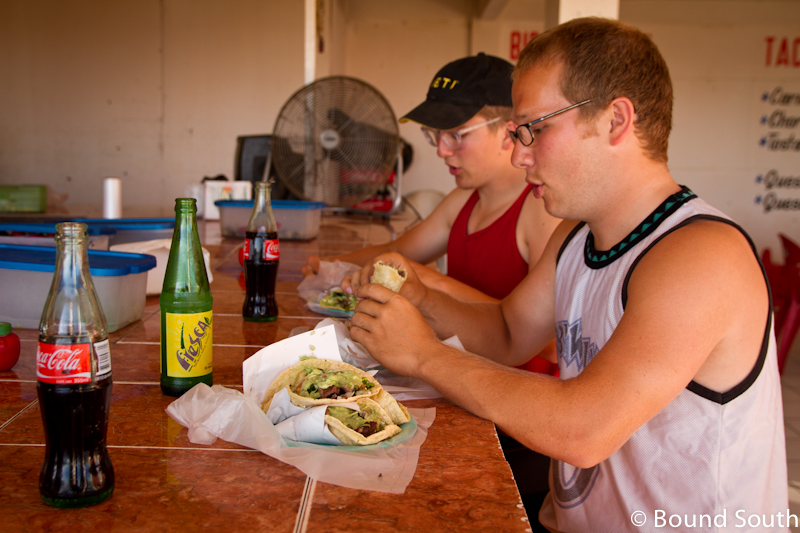
I am sitting here resting in the city of La Paz, on the Sea of Cortez in Mexico’s Baja California Sur.  There is no question: I’m having a really, really good time.  The food in Mexico is spectacular.  I am a North Dakota farmkid who had his own beef cattle growing up as well.  I will never tire of Mexico’s delicious burritos and tacos with beef and beans and rice and more.  What’s more, the seafood in the Baja is spectacular!  North Dakotans sadly miss out on great seafood.  If you ever get the chance, make sure you eat some fresh fish tacos (pescado means fish in Spanish) by the beach because they will change your life.

I hope you had a wonderful Halloween and that you got a ton of candy (and no cavities in your teeth!).  We got our fill of candy from Halloween, that is for sure.  I live on a farm/ranch with my family near Devils Lake.  I have to say, we don’t have close to as many cows as you, but we have a large herd of cats that might give you a run for your money.  Living in North Dakota is a blessing; don’t take it for granted, or else you will only realize how special it is once you’re away.

Sincerely,

Isaiah

Highway One Diaries: Big Sur, Big Cities

Meteorology was left out of our academic preparations for Bound South, perhaps to our detriment.  Riding our bicycle every day, the weather tends to dictate more about our experience than I care to admit.  It is hard not to smile when the sun is shining and the wind is at your back all day (which we truly experienced for the first time in southern California).  I hate to admit it, but a strong wind and a cold rain can incite frustration, tire the legs, and quickly diminish the dream that underpins every day of Bound South.  It also doesn’t help when you’ve been softened by good fortune and good weather.  I’d like to think that we wake up every day reveling in the landscape outside of our tent’s vestibules, the beautiful roads and people that we experience, and the anticipation of what comes next.  For maybe the first time in the trip, forty miles south of the gilded estates of Pebble Beach, I felt a bit tired and insignificant.

The only significant November storm to hit California swept up north of Santa Cruz and whacked us in Big Sur on the California coast.  If you’ve never seen this part of Highway One, it is spectacular.  Spectacular, with a capital S.  The features that make Highway One so famous in the minds of drivers across the United States – the tight curves of a narrow road, the ribbon of pavement sewn to the seaside cliffs and Pacific inlets – made for an unforgettable ride.

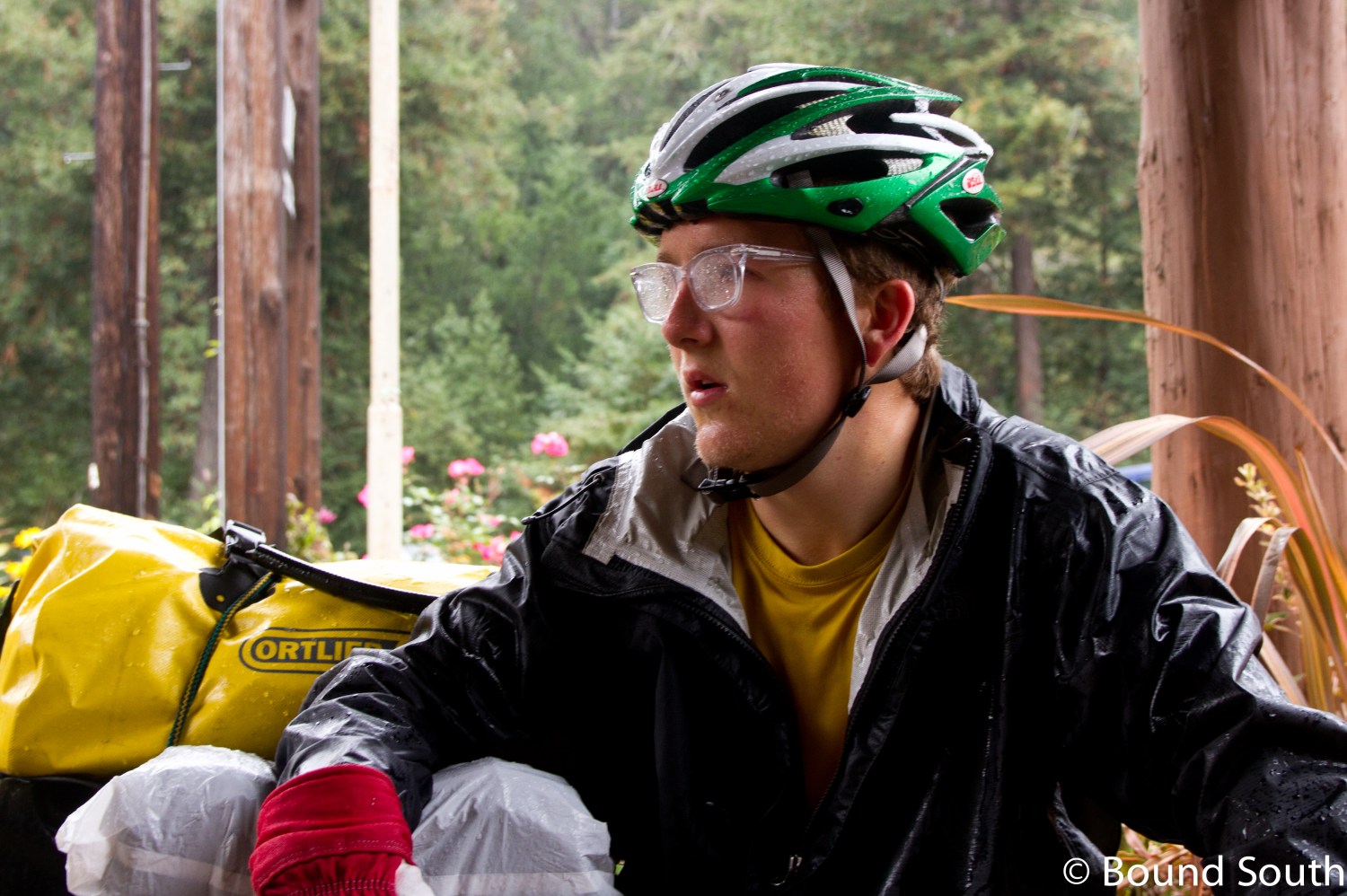
Arriving, wet and cold, outside the too-expensive River Inn Cafe, in Big Sur.

Big Sur gave us a perfect lesson that day.  Torrential rains and 30+ mph headwinds hit us along the outer edges of the cliffs of Highway One.  It’d dispiriting to be cold, wet, and unable to roll downhill without serious effort because of the wind.  At the first sight of human civilization after 40k, we ditched into the warm lobby of a restaurant that was far too expensive for us and begged to sit by the fireplace and dry out.  We had been on a high after seeing family in San Francisco, but now in the empty coastline of California we were cold and insignificant in the face of all that was before us.  We had thousands of miles, seven months, dangerous border crossings, mountains, rivers, and seas separating us from the end and our ride home to North Dakota.  We lack running water, multiple items of clothing, the comforts of constant technology and contact, beds, incomes, and a million other contrivances of the modern world.  I thought about what it would be like to leave all of the danger and the uncertainty behind, go work on an oil rig in western North Dakota, pay off my student loans and try to find some more conventional route through the New Year.

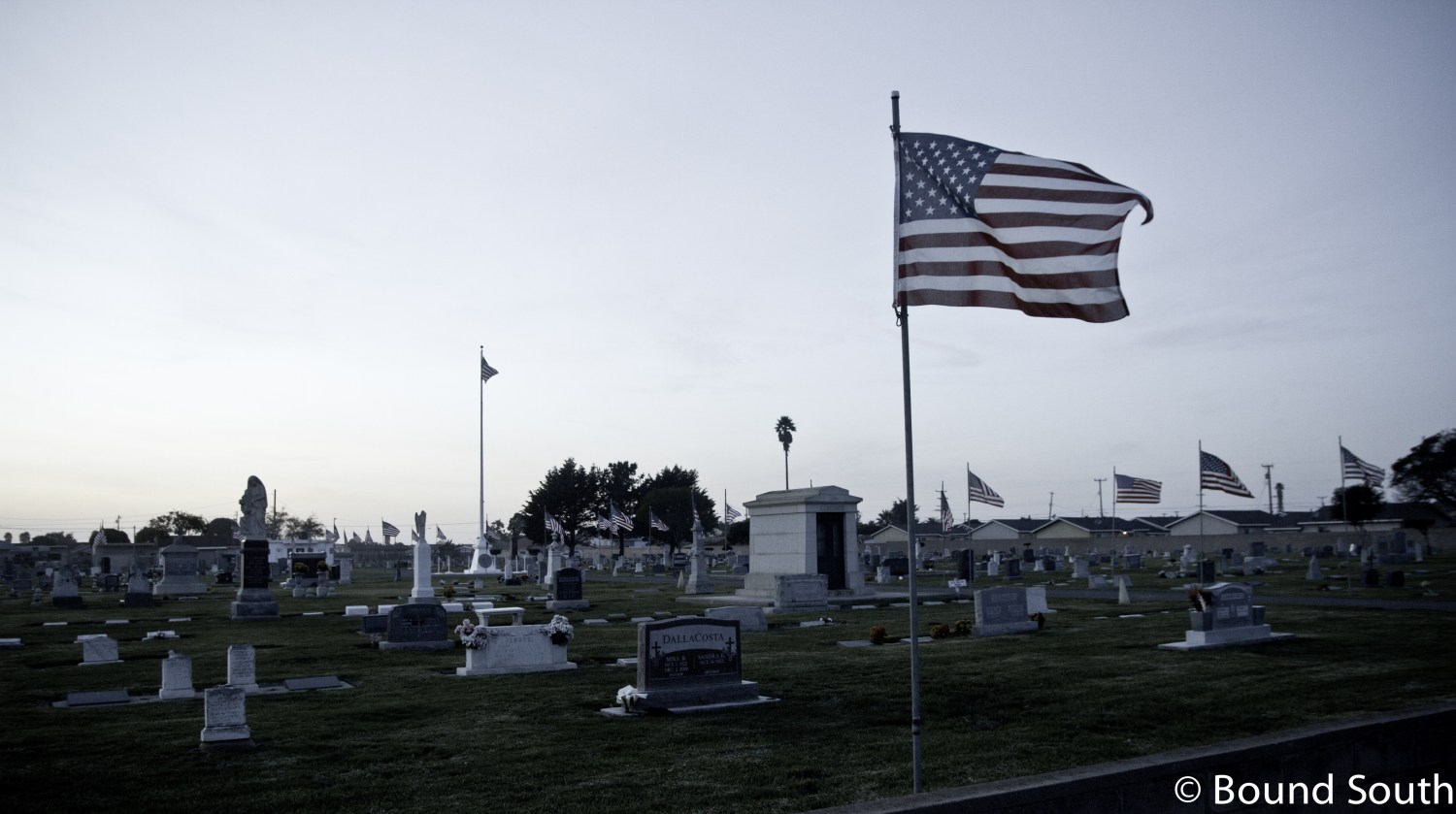
Reverent cemetery passing on Veteran's Day near Solvang.

It would be a lie of sorts not to disclose this.  We aren’t stoic or superhuman; every day is a conscious decision to press on.  The road behind us is a sunk cost.  There is of course the pressure of our natural resolve against failure.  Yet daily we pack up our bags and ride into the sun or the storm, every day another affirmation that the road ahead is worth what we’re leaving behind.  That was true in Big Sur that day, it is true here in Mexico, and every day in between.

We flew through the farm fields full of migrant laborers and big cities of southern California.  Haste and a disdain for the stresses of adverse urban miles gave us plenty of motivation.  Beyond, the vast world south of the US-Mexico border called to us.  Rested in San Diego, we packed our bikes like we always did and decided that a carreterra named Uno was worth what we were leaving behind.

Lunchtime with Lee Saville of 350South. He joined us for southern California. We miss his fellowship.

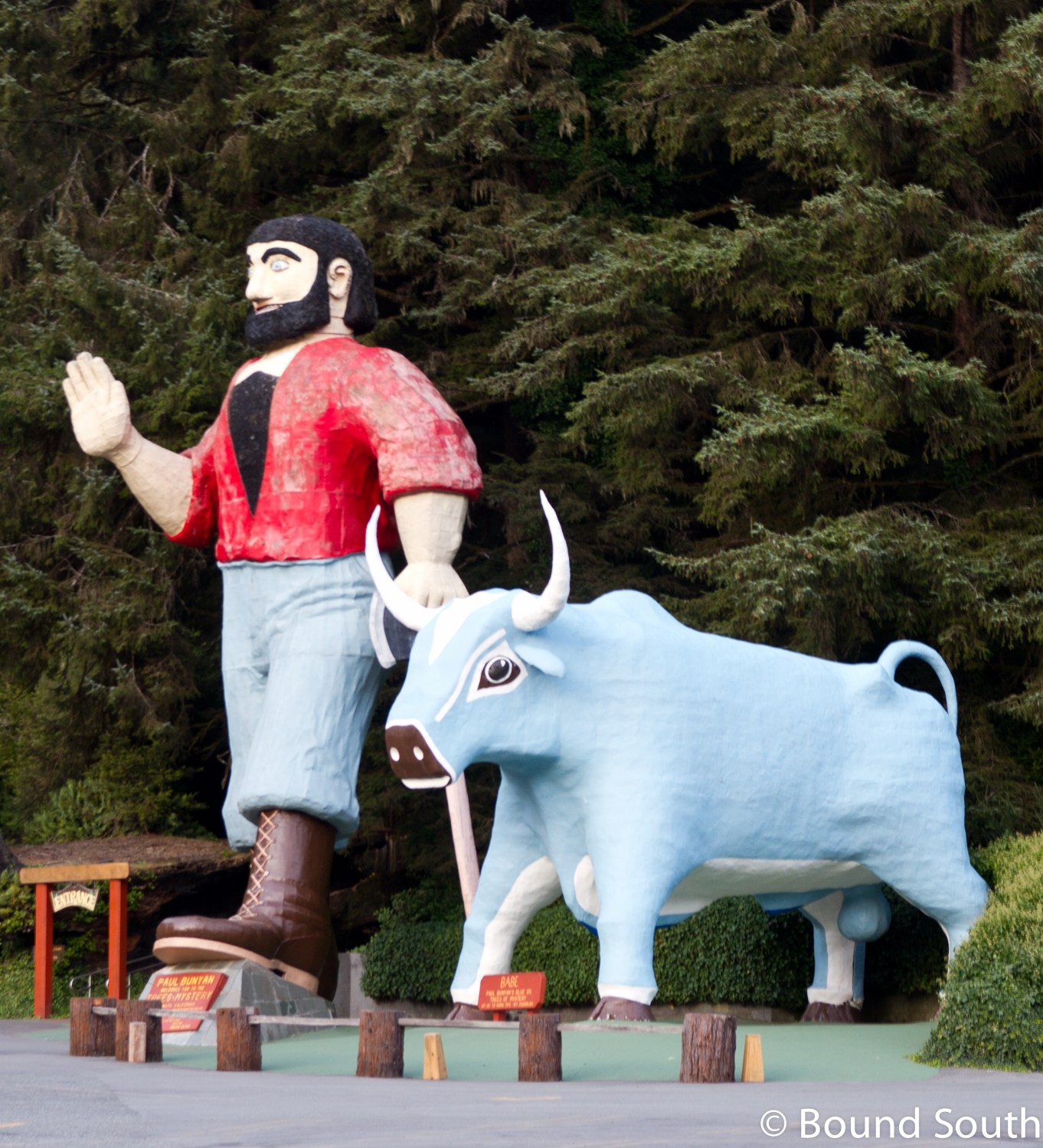
Highway One Diary: Redwood Curtain

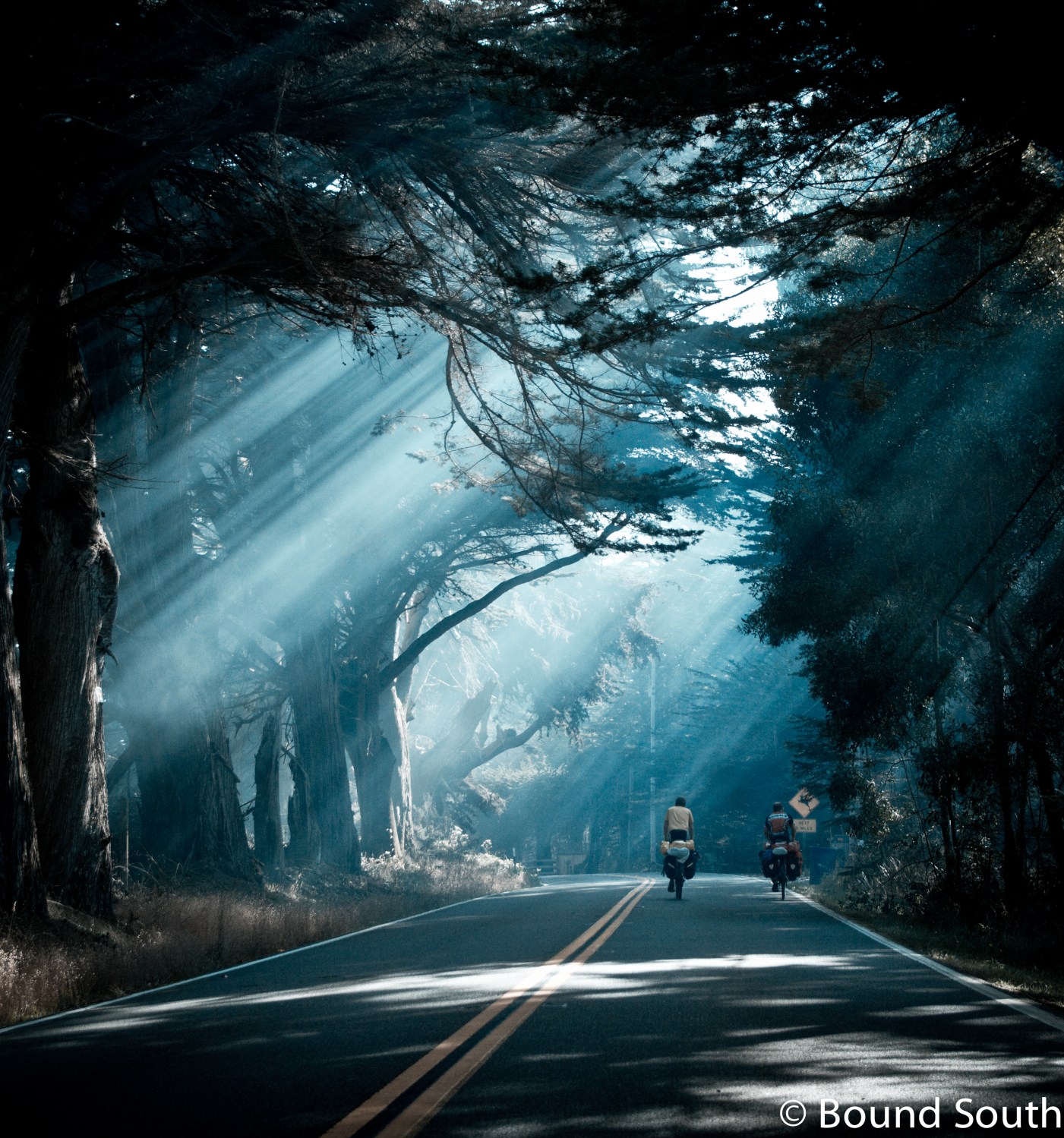
Our_days_with_Highway One began at Crescent City, California.  Lying just across the California state border with Oregon, it is a small little town that we skirted in the Jedediah Redwoods State Park before finally setting our wheels on the smooth pavement of Highway One-oh-One.  Within about a mile we shot (or perhaps struggled?) up a 1,500-foot climb on the coastal highway.  Our sweat and toil was rewarded with our first truly spectacular view of the Pacific.  Like all great roads, it would be easy on the eyes and hard on the legs.

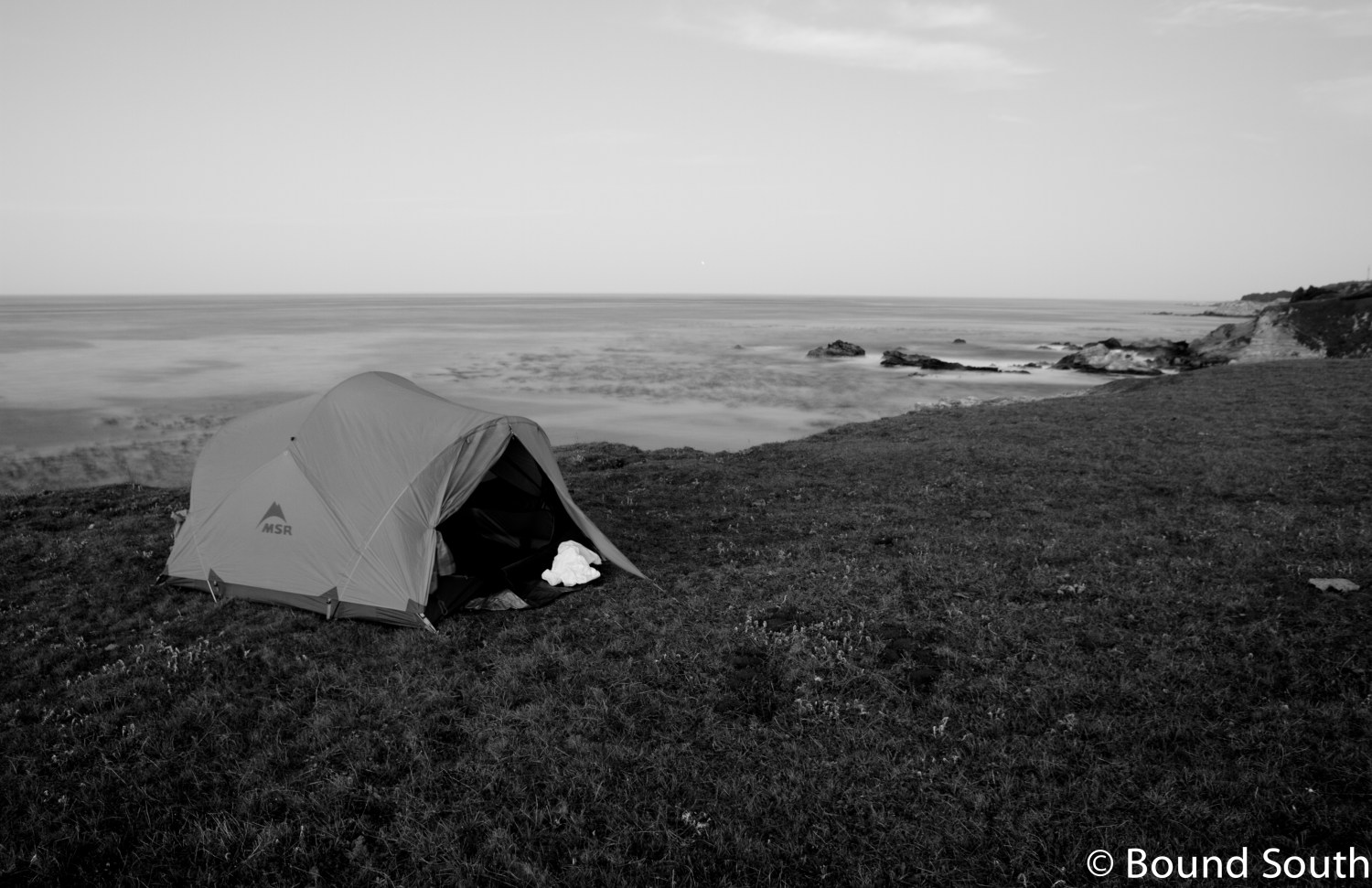
Most nights we slept in our tent, as we always do.  Terrible phenomena of cold and frost were finally behind us (or so we thought).  We awakened most mornings to a rancher’s pasture or a closed campground and sat comfortably over our oatmeal in the gathering light.  In the high North Country we usually woke up concerned with survival, de-icing the tent, and counting down the days to a famously warm and sunny California.

Bicycle touring through a region is always a process of mutual transformation.  We leave few physical signs of our passing, but our impressions with local people and the friendships we form have some power to them.  The places we ride through certainly don’t mark us (provided we don’t crash into them) but they linger in our hearts and legs.  A few miles of sunshine and quiet road can reveal entirely new states of mind.   I hate to admit it, but the edge of toughness can be dulled by too much comfort; and Northern California was pretty comfortable.  We saw no rain or adverse weather conditions on some of the most beautiful road in the United States.  We got a little bit soft, acclimated to a new kind of riding.  Even now it is hard to fathom how we rode through the cold rain in the Yukon and British Columbia in nothing but short-sleeve jerseys and spandex.  In some ways I think we were tougher then, simply because we had to be.  I think a lot of life is like that.

All of California was a cultural revelation for us.  I think we first realized how different North Dakota and California are when we saw that we had just missed the Love Goddess Festival of Mendocino County.  North Dakota would never have a “Love Goddess Festival” and if they did it could only be during the month of July when it is warm enough for everyone to feel love again.  Perhaps I should not describe the culture of my home state as monolithic, but in comparison to Northern California I cannot help but do so.  Every few miles had us greeting atypical variants of hippies, blue-collar loggers, farmers, travelers, vagrants, pastors, and more.  North Dakota has its own kind of wonderful diversity but you have to look a bit harder to find it.  Northern California can be weird and wonderful and many other things all at the same time.  Yet the constant of kindness remained; we’ll never forget meeting Janet on the road, a cyclist out for a late afternoon ride.  We fly pretty fast as far as touring cyclists go.  We passed her and managed to have her stumble upon us down the road while we were looking for directions in the soupy fog of Arcata’s coast.  Within minutes she had offered to take us in.  We met her husband Barry who is an avid surfer, and that evening we were sharing touring memories over pizza and beer.   Amidst big landscapes it proves to be the little things that matter.

Hallowed Highway One

“Enthusiasm” might be too soft a word to describe our anticipation of the roads ahead of us.  Excitement for the next highway is always distracting.  Just last night we talked about the Carretera Austral in Chile.  Great roads are often proxies for the landscapes that they border.  North of California, the State acquiesced to Nature and placed its roads in the hospitable margins of mountain ranges and river gorges and splintered glacial-volcanic landscapes.  Builders of highways and dirt roads worked in the safety of the low passes and river banks.  Political lines were redrawn, roads rebuilt, and names re-chosen (Mount Hood was Wy’East to the Multnomah long ago) while the ancient features remained as they were.  The roads ringed them and so each new turn bowed to the new landscape that bounded it.

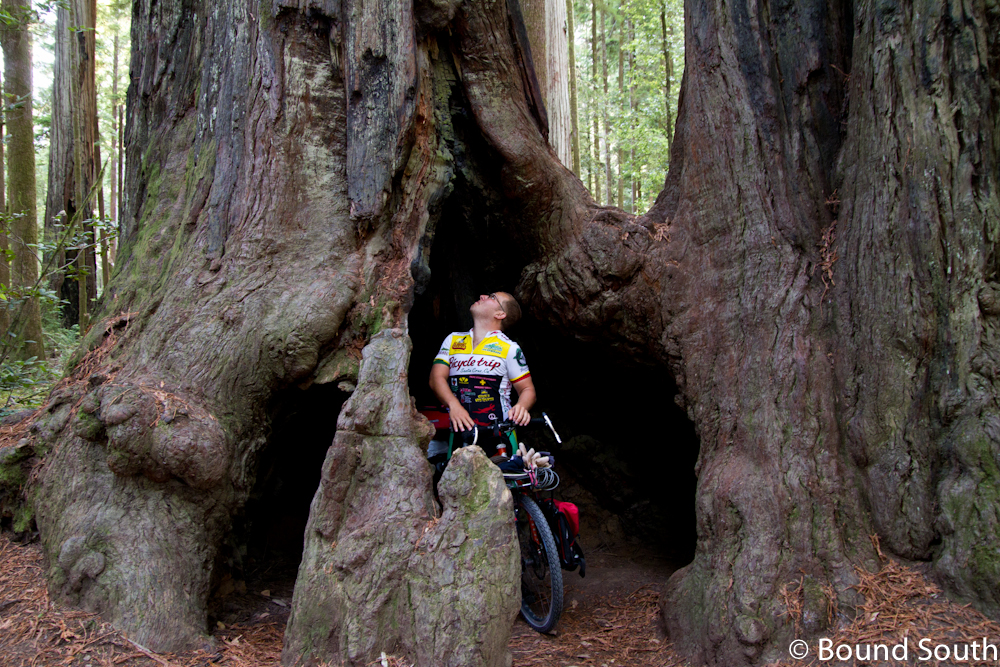
Nathan ponders a camping location in the Redwood Forest.

Highway #1 was always about the ocean.  As we rode out of Oregon it was Highway #1 that distracted our imaginations, bordered as it was by the same ocean that forced us southwards and will one day stop us in Tierra del Fuego.  Since riding through the Redwood Forests of Northern California we have never been more than a day’s ride from the ocean.  Yet while Highway #1 does respect the ocean’s borders out of necessity, it has an independent spirit and longevity that sets it apart from any other road we’ve known since Alaska.

Scene of the crime: countless burritos killed at lunch stop on Hwy 1.

Contrary to popular belief, Highway #1 doesn’t end at Tijuana.  Technically.  Where the United States ends and Mexico begins, so does Mexico’s Highway One.  In Big Sur of California, Highway #1 cuts across the cliffs.  Human engineering defied natural obstacles. It is spectacular to experience it by bicycle, with every sweeping turn made more exciting by the low speed warning signs.    In Southern California we flew through the metropolitan areas of Santa Barbara, Santa Monica, Los Angeles, and San Diego with our eyes already set on Mexico and La Paz.  Now in Mexico, we have felt like our journey has truly just begun.  The vast majority of our journey takes place in the Spanish-speaking world, after all.

A different kind of American agriculture in the fields near Santa Cruz.

Highway One has a lot of stories to share from the Redwoods to the inhospitable Mexican desert.  In the coming days we’ll be publishing our Highway One Diaries, a short series of posts that will illuminate our ride down this singular ribbon of road.

Mailbag Monday #1

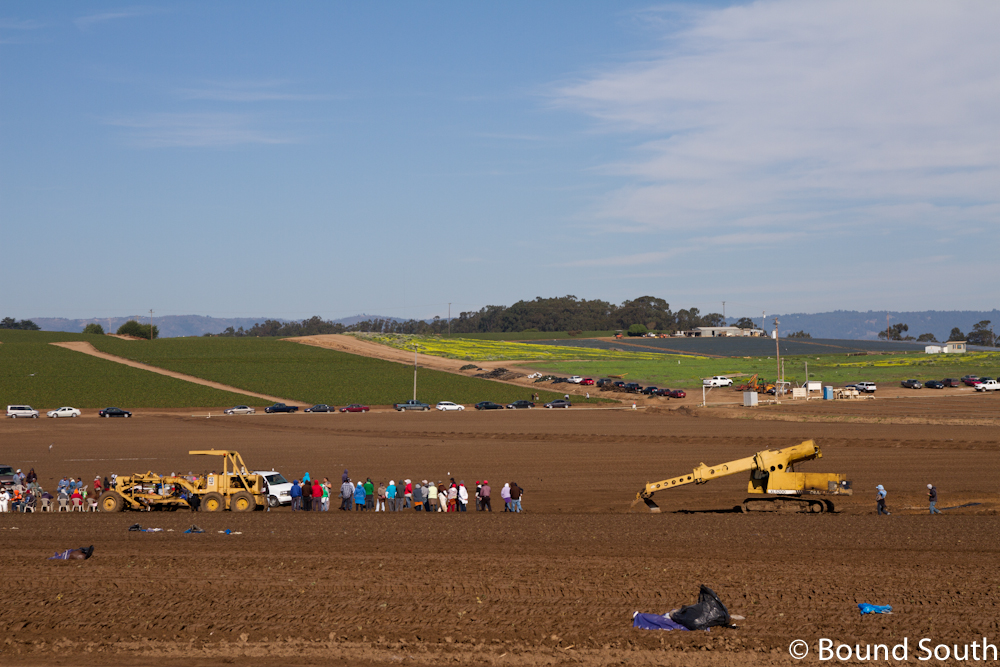
For the past few weeks we have been enjoying a number of letters from some very special students.  We were notified that an elementary school in North Dakota was enraptured by our journey from Alaska and was eagerly following our every posting about Canadian mudslides and bike rides and more.  At our last mail drop, we got their letters; countless handwritten missives by third-graders who were quite enthusiastic to share our North Dakotan commonalities and investigate the strange wonders of our bicycle expedition.  Monday will now become Mailbag Monday at Bound South, where we will share these letters and our responses.


Dear Isaiah,

My name is Michaela.  I am 9.  I do not like to ride bike up hills but I love going down them.  Do you like riding bike?  How long do you ride a day.  Do you ever get tired?  Is there anything you are really looking forward to?  I drove to Vermont with my moms friend Gary, my grandpa, my mom, and my brother.  I live in ND.  What are all of the states you are going to see?  And how on earth did you make your own bike?  My class is third grade.  How old are you?  when is your birthday?  What is your favorite color?  My birthday is July 2, 2002.  My favorit color is black.  Do you ever eat at a restraunt?  Do you get to go to bed or do you drive that whole time?  Why did you choose to ride bycycle?  I would drive atleast a motorcycl.  I hope you don’t fall off your bike with all that stuff on it.  I have three siblings Austin, Carter, and Jason.  They are all boys!  I think yours are David and Nathan, hey, they are all boys too but I am a girl and you are obviously a boy.

Sincerely, 

Michaela

Dear Michaela,

I have always liked to think that I love riding bike uphill and downhill.  I just love riding uphill a lot less!  Riding bike for me is about freedom; it’s a form of incredible transportation that can take you almost anywhere under your own power.  It’s the mechanical fulfillment of the human engine.  It is beautiful to me, even when I am totally exhausted from it.  Yes, even us three Pan-American bicycle adventurers get tired from riding!  We like to ride about sixty or seventy miles in a day.

I think that I am looking forward to the vast regions below the US-Mexico border more than anything.  The Andes and Tierra del Fuego are always on my mind, but they do not distract me from the beauty I get to see every day.  The US states of Idaho, Washington, Oregon, and California have been spectacular in their own way and I hope that we capture that on our website.

I’m 22 years old, I was born on June 15th, and my favorite color is blue.  I most definitely sleep at night, and sometimes even during the day when I get the chance.  If I ever get the crazy idea to do this trip again one day, I bet I’ll be riding a motorcycle and eating at more restaurants.  I hope I don’t fall off my bike either!  If there was ever any doubt about whether we were boys, this trip has cleared it up.

Sincerely,

Isaiah